
Радиоуглеродное датирование : маленькие образцы
Что есть.
Огромное число образцов, которые идут в работу, является либо относительно маленькими либо состоит из материалов с низким содержанием датируемого углерода, дают счетные образцы ограниченной массы. В обоих случаях применение традиционного метода приводит к малой порции бензола.
Предмет.
Мы должны приготовить пробу бензола с наиболее высоким (по возможности химическим выходом, а затем провести измерение удельной активности бензола с минимальным разбавлением материала пробы.
Выводы.
- Применение современной бензольной линии позволяет работать с образцами, для которых возможно
синтезировать 100-200 мг бензола с высоким химическим выходом, а по запросу данный модуль для микропроба может быть включен в комплект оборудования.
- Применение гидролизатора (см. п.4.2 в спецификации ), который позволяет Вам применить капсульную технологию для производства карбида лития.
- Капсульная технология
является прогрессивной, поскольку позволяет получить одновременно несколько образцов (карбид) в одном и том-же процессе
и, что более того, позволяет обрабатывать полученные пробы карбида спустя какое-то время поскольку каждая проба герметична - может долго храниться.
- Применение антирадонового модуля сокращает время стабилизации пробы перед подсчетом, что наиболее важно для небольших проб бензола.
Как было установлено (
Robert M Kalin and Austin Long, 1989 ) традиционные Teflon виалы могут иметь ограничения, поскольку занимают много времени в подготовке и они могут требовать индивидуальную калибровку и могут иметь существенные потери бензола.
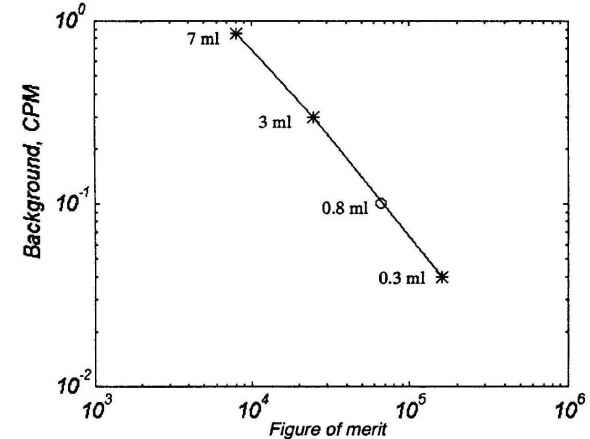
Виалки из специального стекла ( A.G. HOGG, 1992 ) могут перекрыть широкий интервал объема измеряемого бензола
(0.3 мл до 10 мл), когда 10 мл виалы наиболее применимы для прецезионных измерений радиоуглерода и когда 0.3 мл виалы применимы для получения аккуратных результатов с адекватной точностью для многих применений для образцов содержащих
120-240 мг углерода.
В дополнение к этому показано, что применение подземной лаборатории (
Wolfango Plastino and Lauri Kaihola, 2006 ) может значительно снизить счетный фон.
Разработки ( Michael Buzinny and Vadim Skripkin, 1995 ) позволили создать двухкомпонентные виалы (0.8 мл Teflon) с различными держателями, которые имеют вполне хорошие показатели, описанные ниже. Сейчас мы предлагает наиболее современные Teflon виалы опубликованные совсем недавно ( Skrypkin and Buzynnyi, 2017) c превосходными характеристиками (см. фото выше), которые имеют длительную службу, просты в обращении и имеют различный фикси рованный объем: 0.8 мл, 1.5 мл, 2.5 мл, 4.0 мл и 7.0 мл и имеют очень низкую утечку бензола.
Получение бензола (маленькие образцы).
Капсульная технология производит бензол с высокой эффективностью. Она позволяет работать с маленькими пробами. Она широко применима для проб органики и для проб карбонатов. Она дешовая и высокоэффективна. Она дает упрощение всех процессов благодаря высокой чистоте получаемого карбида лития.
Микролайнер технология терморазрушения и простая и высокопродуктивная для всех типов материала образцов.
Литература / References.
Robert M Kalin and Austin Long. Radiocarbon Dating With The Quantulus In An Underground Counting Laboratory: Performance And
Background Sources. RADIOCARBON, VOL 31, No. 3, 1989, PP 359-367.
A.G. HOGG. Performance And Design Of 03-Ml To 10-Ml Synthetic Silica Liquid Scintillation Vials For Low-Level 14C Determination.
Liquid Scintillation Spectrometry 1992, edited by J.E.Noakes, F. Schonhofer and H. A. Polach. RADIOCARBON 1993, pp. 135-142.
Wolfango Plastino and Lauri Kaihola . Liquid Scintillation Counting At Gran Sasso National Laboratory: radiocarbon measurements.
LSC 2005, Advances in Liquid Scintillation Spectrometry. Edited by Stanislaw Chalupnik, Franz Schonhofer,John Noakes. pp 435-438.
Michael Buzinny and Vadim Skripkin. Newly Designed 0.8-ML Teflon Vial For Micro-Volume Radiocarbon Dating.RADIOCARBON.
Vol 37, No 2 (1995) PP. 743-747
Vadim Skripkin, Mykhailo Buzynnyi. Teflon Vials for Precise C-14 In Benzene Measurements by LSC Technique.
LSC-2017 - an International Conference on advance in Liquid Scintillation Spectrometry, 1-5 May, Copenhagen, Denmark. Book of abstract. p.72.
Vadim V Skripkin, Nikolai N Kovaliukh.
Production Of Lithium Carbide From Very Small Organic And Carbonate Samples For Liquid Scintillation Radiocarbon Analysis.
ZESZYTY NAUKOWE POLITECHNIKI SLASKIEJ - 1996. Seria: MATEMATYK A-FIZYKA z. 79. GEOCHRONOMETRIA 13. Nr kol. 1330
Радиоуглеродное датирование : маленькие образцы
