Background
A huge number of C-14 dating samples are either relatively small or their material contains a low concentration of carbon, dated with limited sample mass. In both cases, conventional radiocarbon dating results in small portions of benzene.
Solutions
- •Application of modern benzene line allows working with samples for which it is possible to synthesize 100–200 mg of benzene at high chemical yield.
- •Hydrolysis module (See p. 4.2 of specification) allows applying capsule technology to produce lithium carbide.
- •Capsule technology — allows preparing a few samples in the same process. Each sample is hermetic and can be stored.
- •Anti-radon module decreases time of sample stabilization before counting.
Teflon Vial Performances
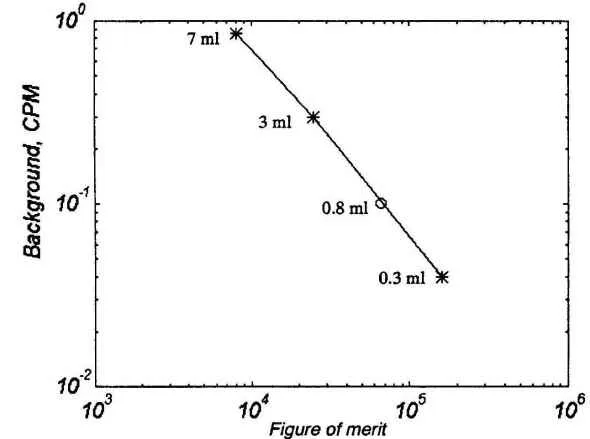
Counting performance: FOM vs Background
Recent developments created super performance Teflon vials with long durability, simple to use, in volumes: 0.8 ml, 1.5 ml, 2.5 ml, 4.0 ml, 7.0 ml — with extremely low benzene leakage.
Application of underground laboratory (Plastino and Kaihola, 2006) can significantly decrease counting background. Special glass vials (Hogg, 1992) cover 0.3 ml to 10 ml range.
Producing Benzene (Small Sample)
- Capsule technology — produces carbide highly productively. Allows simplification of the entire scheme because of highly pure carbide.
- Microliner thermodestruction technology — simple and highly productive for any kind of sample material.
References
- Robert M Kalin and Austin Long. Radiocarbon Dating With The Quantulus In An Underground Counting Laboratory. RADIOCARBON, Vol 31, No. 3, 1989.
- A.G. Hogg. Performance And Design Of 0.3-Ml To 10-Ml Synthetic Silica Liquid Scintillation Vials. RADIOCARBON 1993.
- Michael Buzinny and Vadim Skripkin. Newly Designed 0.8-ML Teflon Vial. RADIOCARBON. Vol 37, No 2 (1995).
- Vadim V Skripkin, Nikolai N Kovaliukh. Production Of Lithium Carbide From Very Small Samples. GEOCHRONOMETRIA 13, 1996.