
We use some base ideas of benzene synthesis for sample preparation. Initial ideas were published (Skripkin & Kovaliukh, 1998; Buzinny & Skripkin, 1995) and all future developments are included in materials used in Benzene Line, and knowledge given in user's manual and during staff training.
General Approach
Our general approach is to optimize volume (diameter and length) of benzene line and use selected materials — Teflon, Titanium, Stainless Steel, and Boron-Silicate Glass. In addition we can use ionizing air (ozone) for cleaning of the line.
We produce highly effective long-lasting chromium-based catalyst which is reusable and applicable for continuous work. The equipment set includes catalyst required for at least two years of intensive work.
Laboratory Glassware
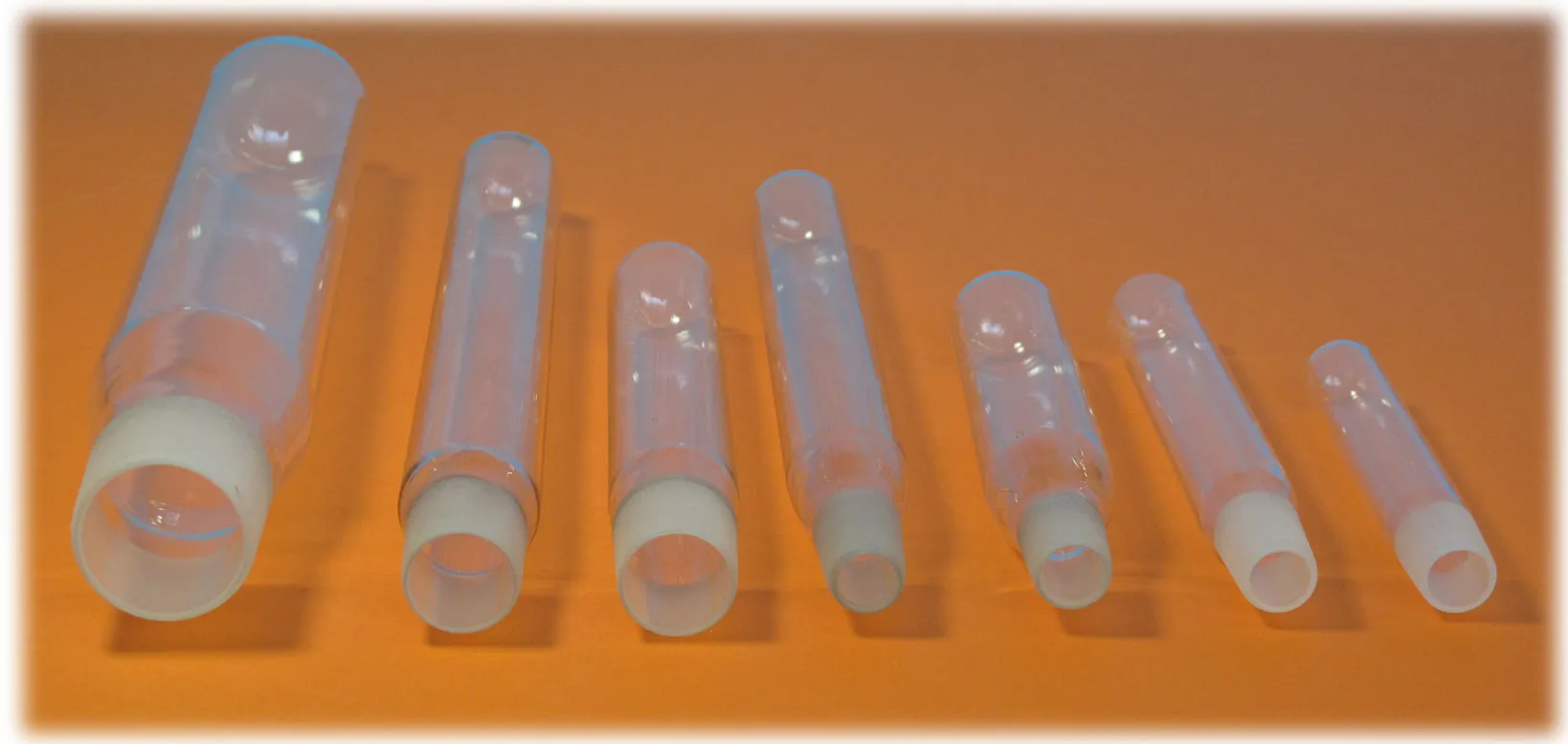
Laboratory glass reaction vessels
We take care about problems arising in glass benzene lines — it is too hard to keep a large internal volume vacuum line hermetic. So we use only high-performance glassware:
- •High quality tubes of three different diameters for producing glass reaction vessels with cone connections.
- •Boron-silicate glass tubes produce glass reaction vessels applicable for all stages of sample conversion.
- •Cone connections allow simple connect/disconnect of any glass reaction vessel with Teflon holders.
- •Working temperature range: −200 °C to +600 °C.
Modern Approaches
We use modern approaches in sample processing: cryogenic trapping and sublimation, vacuum pyrolysis, capsule technology and microliner thermodestruction technology. These allow a variety of novel applications: radiocarbon dating, estimation of environment impact, and tests of bio-based content. Moreover, one can use benzene line for tritium analyses achieving better counting performances for low-level tritium measurement.
Equipment Includes
Combined anticorrosive metal reaction vessels — highly effective and productive
Optimized vacuum line: stainless steel tubes, Teflon holders-connections
High performance glass reaction vessels serving as bubbler, reaction vessel and/or vacuum trap
Teflon Vials — high performances and long durability
Vertical ovens working at 500, 700, or 800 °C
Highly effective and reusable catalyst
Video Resources
References
- Vadim V Skripkin, Nikolai N Kovaliukh. Recent developments in the procedures used at the SSCER Laboratory for the routine preparation of lithium carbide. RADIOCARBON. Vol 40, No 1 (1998)
- Michael Buzinny & Vadim Skripkin. Newly Designed 0.8-ML Teflon Vial for Micro-volume Radiocarbon Dating. RADIOCARBON. Vol 37, No 2 (1995) PP. 743-747
- VV Skripkin, MG Buzynnyi. Teflon Vials For Precise C-14 in Benzene Measurements by LSC Technique. Biological and Chemical Research 4 (Issue 9), (2017) 229-233