
Application in Radiocarbon Dating
Benzene Line widely uses vacuum pyrolysis in the benzene production process. The approach (Skripkin and Kovaliukh, 1998) offers the advantage of a single-stage, highly efficient and economical procedure for the production of lithium carbide.
It is applicable for most types of sample material encountered in routine dating work, including organic detritus dispersed in a highly (up to 95% by weight) mineral matrix and/or carbonates. Bone collagen can also be processed without the need for its prior extraction and purification.
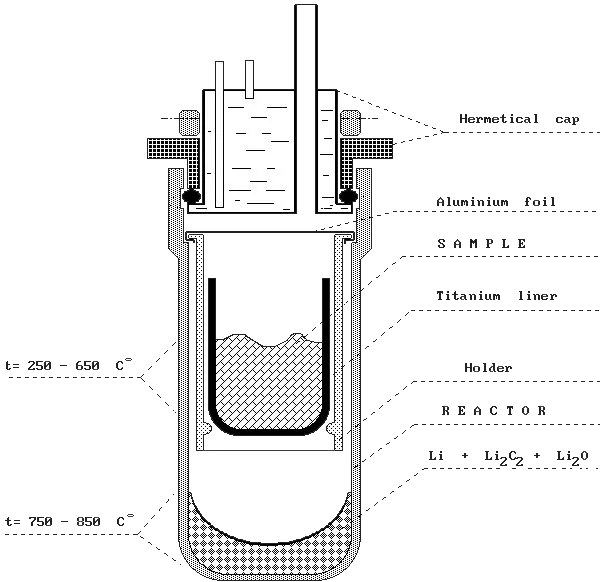
Scheme of high temperature reaction vessel (1998)
Development
The initial idea of vacuum pyrolysis application in radiocarbon dating was published in 1998. Future developments are enclosed in materials used in Benzene Line, and knowledge given in user's manual and during staff training. We use selected materials — Titanium, Teflon, Stainless Steel and Boron-Silicate Glass. Our general approach is to optimize volume (diameter and length) of benzene line. Vacuum pyrolysis fits into the base idea of benzene line — minimization of volume — in a metal reaction vessel.
Novel Applications
- •Capsule technology — produces carbide highly productively; allows obtaining small benzene samples; well applicable for both organic and carbonate samples; cost-effective.
- •Microliner thermodestruction technology — simple and highly productive for any kind of sample material; cost-effective and extremely efficient.
Advantages
Applicable For
- •Different sample materials
- •Different sample matrices (solid, gases, liquid)
- •Fractioning materials
- •Highly contaminated samples
- •Low carbon materials